




POS for food stalls & small eateries
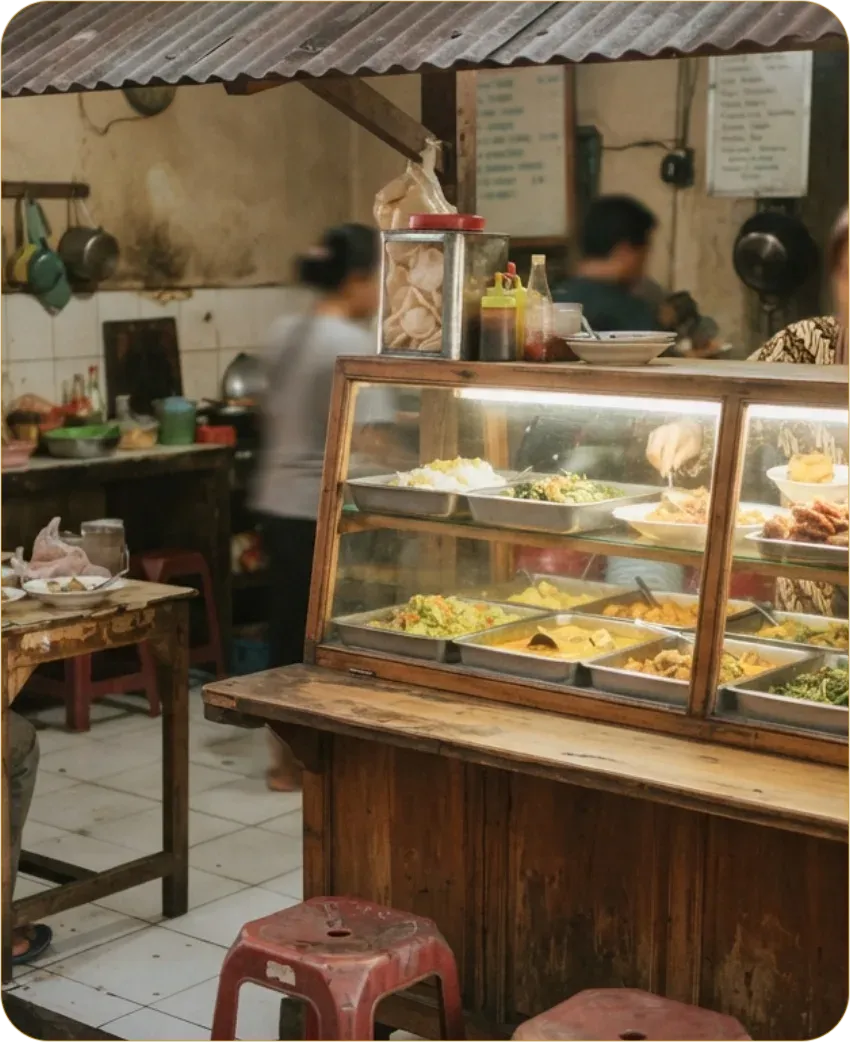
From one bowl of noodle soup, Bu Sum knows her profit.
Follow one day at Warung Bu Sum. The first order, Rp 46,000 at 7 in the morning: noodle soup made from a recipe, crackers bought in ready-made, and iced tea. That night Bu Sum knows the day's profit without adding it up in a notebook.
Also fitsCoffee stalls (warkop)Rice stallsMeatball & noodle stalls
07:10 · Queue D-001 · Tika
Dine in
Rp 46,000 · cash
Receipt · INV/2026/10/09607:10
- 2 × Noodle soup with egg
- Rp 32,000
- 2 × Crackers
- Rp 4,000
- 2 × Iced tea
- Rp 10,000
- Paid by
- Cash
TotalRp 46,000
- Orders today
- 76 orders
- Sales
- Rp 1,840,000
- Gross profit
- Rp 1,020,000
- To buy
- 2 ingredients
The food stall problem
The stall is busy every day, but the profit is never clear.
At a food stall, market money and takings end up in the same drawer. Some dishes are cooked in-house and some goods are bought in ready-made, so the real profit is hard to work out without records.
01You don't know what a bowl of noodle soup costs you.
The recipe records what goes into each dish: one pack of noodles, one egg, vegetables and spices. Its cost comes from your market prices.
Step 0202Nobody works out the profit on bought-in goods (crackers, bottled drinks).
Bought-in goods are stocked products with their purchase price. Crackers bought at Rp 1,500 and sold at Rp 2,000 make Rp 500 profit.
Step 0203Eggs run out in the middle of the day.
Ingredient stock goes down with every order, so you can see when it's time to shop.
Step 0304The cash in the drawer doesn't match sales.
The drawer is opened and closed per cashier, and the expected cash is calculated automatically from cash sales.
Step 05
Simulation · One day at Warung Bu Sum
One working day, from the first bowl to closing the drawer.
Warung Bu Sum is on F&B Starter with two users: Bu Sum, and Tika at the till. Every number below is what appears on screen in Tumra.
- 07:1001 · Checkout
The first order, with a queue number.
Tika opens the drawer with a Rp 200,000 float. Two customers eat in: 2 noodle soups with egg, 2 crackers, and 2 iced teas. They pay Rp 50,000 in cash, Tika gives Rp 4,000 change, and the order gets number D-001.
Point of sale (POS)Receipt · INV/2026/10/09607:10
- 2 × Noodle soup with egg
- Rp 32,000
- 2 × Crackers
- Rp 4,000
- 2 × Iced tea
- Rp 10,000
- Paid by
- Cash
TotalRp 46,000
From the same receipt · no re-entry
02 · Cost · 07:10
Cost from recipes and from purchase prices.
The noodle soup and iced tea use recipes. The crackers are bought in ready-made, so their cost is their purchase price. The profit on this receipt goes straight into today's gross profit.
Products & stockProfit breakdownINV/096
- Noodle soup with egg (noodles 3,000 + egg 2,000 + veg & spices 1,000) × 2
- Rp 12,000
- Crackers (bought at 1,500) × 2
- Rp 3,000
- Iced tea (recipe 1,000) × 2
- Rp 2,000
- Cost
- Rp 17,000
Gross profitRp 29,000
03 · Stock · 07:10
Ingredients go down without being entered again.
Noodles, eggs, and crackers go down as soon as the receipt is paid, by recipe and by the quantity sold.
Products & stockStock · Warung Bu Sum07:10
- Instant noodles
- 40 → 38 packs
- Eggs
- 30 → 28
Crackers50 → 48
- 13:0004 · Shopping
Market shopping is recorded, stock goes up.
Only 22 eggs are left. Bu Sum goes to the market, then records the goods received. Stock goes up, and the prices she paid feed into the average cost used for the next dishes. The shopping is paid from the stall's cash, not from the till drawer.
Sales & purchasingGoods received · PB/2026/10/01413:00
- Eggs
- 60 × Rp 2,000
- Instant noodles
- 40 packs × Rp 3,000
- Crackers
- 50 × Rp 1,500
TotalRp 315,000
- 21:0005 · Close drawer
The cash in the drawer matches.
Tika counts the cash and closes the drawer. The Rp 260,000 paid by QRIS doesn't count as money in the drawer.
Point of sale (POS)Drawer close · Tika21:00
- Opening float
- Rp 200,000
- Cash received
- Rp 1,580,000
- Expected
- Rp 1,780,000
- Counted by Tika
- Rp 1,780,000
DifferenceRp 0
21:30 · owner
The stall is closed, and Bu Sum knows today's profit.
Bu Sum doesn't need a notebook. On her phone, she sees the results of 76 orders and the ingredients to buy tomorrow.
Today's profit
From recipes and average purchase prices, not a guess.
Best sellers
Noodle soup with egg, iced tea, rice with egg.
Ingredients to buy
Two ingredients below their reorder point.
Cash in the drawer
Matches cash sales, recorded under Tika's name.
Today's summary · Warung Bu Sum
Tuesday, 13 October
- Sales
- Rp 1,840,000
- Gross profit
- Rp 1,020,000
- Cash
- Rp 1,580,000
- Shopping today
- Rp 315,000
76 orders
55.4% of sales
QRIS Rp 260,000
PB/2026/10/014
To buy · 2 ingredients
- Sugar0.5 kg / reorder at 2 kg
- Tea bags15 / reorder at 50
Features used
The features behind that day.
You have seen every feature below at work in the simulation. Open its page for the full details.
- Point of sale (POS)Steps 01 · 05Queue numbers, Dine in/Takeaway, cash and QRIS, the drawer.
- Products & stockStep 02Cost per dish from ingredient measures.
- Products & stockSteps 02 · 03Bought-in goods at their purchase price, ingredient stock deducted automatically.
- Sales & purchasingStep 04Market shopping recorded as goods received, with stock and average cost updated.
- AccountingOwnerDaily profit without adding it up by hand.
The plan Warung Bu Sum uses
One plan runs that whole day.
A stall with more than about 15 orders a day uses F&B Starter, because F&B Free is capped at 500 sales a month.
Used in the simulation
F&B Starter
Rp 71,600Rp 179,000/month, incl. VAT
- Users
- 2 (max. 3)
- Checkout locations
- 1
- In the simulation
- Bu Sum + Tika
- Queue numbers, Dine in/Takeaway
- Recipes and cost per dish
- Ingredient stock and shopping
- Accounting and reports
FAQ
Common questions, honest answers.
We answer plainly, including what Tumra can't do yet.
A good fit if
- You want to know your profit without adding it up in a notebook
- Your cashier has a phone or tablet with internet
Not a fit yet if
- The internet at your stall often goes down
- You only need a receipt calculator, with no stock
01I never weigh my ingredients. Can I still use it?
Yes. Fill in the recipe with a rough measure per portion. Or use periodic costing: ingredient cost is worked out from the change in stock when you do a stock count, with no recipe per portion. In this mode, the per-item report doesn't show cost.
02I buy crackers and bottled drinks ready-made. How do I record them?
Set them up as stocked products at their purchase price, for example crackers at Rp 1,500. Every time one sells, stock goes down and its cost comes from the average cost, so the profit goes into your daily profit and the per-item report.
03Does the POS work when the internet is down?
Not yet. Checkout runs in the browser and needs an internet connection when you press Pay. If the connection drops in the middle of a sale, pressing Pay again continues the same sale, so it isn't recorded twice.
04Can I use it from my phone?
Yes. Checkout runs in the browser on a phone, tablet, or laptop, with no extra app. Receipts print through the browser's print dialog to a 58 or 80 mm thermal printer.
05Can I record customers who buy on credit?
Yes. Customer credit is recorded at checkout under the customer's name, and new customers can be added right from checkout with a name and phone number. You can set a credit limit per customer, and they can pay it off in parts.
06What happens if I go over 500 sales a month on F&B Free?
Checkout keeps working, and no sale is held back. From 400 sales, a reminder appears at checkout and on the dashboard. If last month went over 500, opening a new shift the following month asks you to upgrade first. A shift that's already open isn't cut off.
Get started
Ring up your first bowl tomorrow morning.
Add your menu and market prices, and see your first day's profit that same night. Free for 30 days, no credit card.
- Start on the Free plan
- No credit card